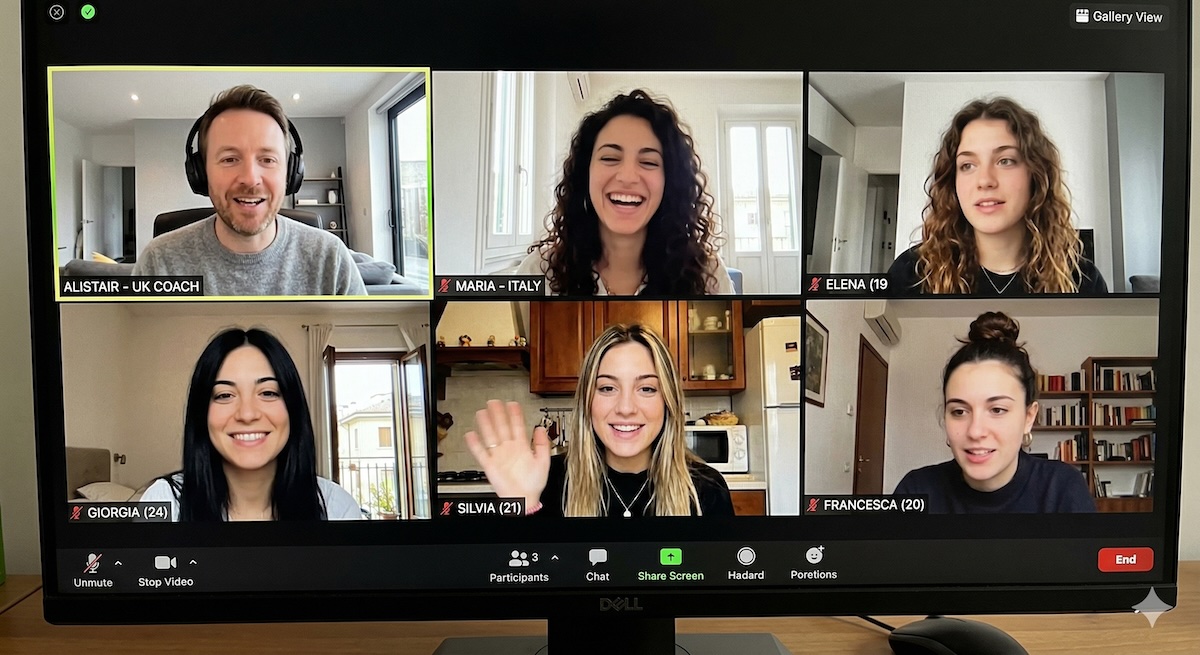
What Happens Inside the Thursday Fluency Clinic (and Why It's Not Like Any English Class You've Taken)
You've prepared for the presentation. You know your material. But when you open your mouth in front of 20 people, your English tightens. You drop articles. Your sentences crack in half. Afterwards, you think: I knew what to say. I just couldn't say it.
This is the problem the Fluency Clinic solves.
It's not a class where you sit through grammar rules. It's not a conversation partner exchange where you chat about your weekend. It's a 60-minute live diagnosis of the specific English situations that are costing you credibility, opportunity, and peace of mind. You bring the situation. I diagnose the problem. We fix it together. Then you leave knowing exactly what to do next time.
Here's what actually happens inside.
The Setup
Twelve people. One hour. Real situations.
The clinic starts at 18:00 CET every Thursday. People join from Berlin, Madrid, Zurich, Milan, Amsterdam. They're marketers, engineers, consultants, founders, finance directors. They're all fluent enough on paper. In meetings, on calls, in presentations, that's where the gap opens.
The format is simple. You book. You arrive. You bring your situation. That might be:
- —A presentation you're giving next week where you need to sound confident and clear.
- —An email you've rewritten four times and still don't trust.
- —A meeting where you froze last time and need to know how to push back without sounding rude.
- —A client call where you stumbled over a key explanation and lost the deal.
- —A situation where you said something and immediately thought: that's not what I meant.
I ask questions. I listen. I diagnose.
What Diagnosis Looks Like
Here's a real example from clinic planning.
A Spanish marketing director walks in. She's been asked to open the quarterly town hall next week. She knows what she wants to say. She's written it down. But she's worried about her opening line.
She reads it: "Today we're going to talk about the results of the Q1 campaign and what we've learned from the market feedback."
It's correct English. But it's not how confident people open presentations in English-speaking companies. It's not wrong. It's weak. It's the kind of opening that makes the room lean back instead of forward.
I ask: What do you want them to feel in the first ten seconds?
She says: That we've done something significant. That I'm not nervous. That this matters.
That's the diagnosis. Not a grammar problem. A register problem. A confidence-through-phrasing problem.
The fix takes four minutes. "We've just closed one of the strongest quarters in the company's history. These are the numbers. This is how we got here. And this is what we do differently tomorrow." Shorter. Active. Specific. She practises it twice in the room. The next morning, the opening lands differently.
The whole clinic learns from this.
A Swiss banker in the session has a different problem. He's angry at a US client who keeps moving the deadline. He wants to push back, but in his last call, his tone came across as defensive. He's worried that direct English pushback sounds aggressive when filtered through his Swiss accent.
He shows me the email he drafted: "I would like to bring to your attention the fact that the deadline has been moved several times, which is making it difficult for us to deliver the quality you're expecting."
Correct. Formal. Stuck. And it's not his voice at all.
I ask: What are you actually feeling?
He says: I'm frustrated. I'm tired of being pushed around.
The rewrite is four sentences: "The deadline's moved three times now. Our team can handle it, but I need to know the final date before Monday. What's changing on your end? Let's fix this together." It's direct. It's fair. It's not aggressive. It's the sound of someone who respects himself and the client enough to say what he actually means.
He reads it aloud. The room feels the difference immediately.
A German consultant who was listening starts nodding. Her situation is different on the surface. She's stuck in a presentation where the CEO kept asking questions she hadn't prepared for. But the root is the same. She goes quiet when she feels uncertain. In English, quiet reads as not knowing. The diagnosis isn't about being more confident. It's about learning three phrases that buy you two seconds to think, and then staying present enough to actually answer the question you heard, not the question you feared.
All three situations land differently. All three hit the same pattern.
Why This Works
The clinic works because it's not about fluency in the abstract. It's about the gap between what you can do in a quiet moment with time to think, and what you can do when the pressure is on.
That gap isn't closed with more grammar lessons. It closes with diagnosis and repetition. You find out what's actually happening (not what you think is happening). You get the exact phrase or structure or approach that works in English. You practise it. You own it. Then you take it into the world.
The group learning is the accelerator. When an Italian engineer hears the Spanish director's opening-line problem, he recognises his own. He's got the same issue with emails that should sound authoritative but read as hesitant. When the Swiss banker practises his pushback, the consultant sees herself. The pattern repeats across different industries, different languages, different situations. But the solution is the same.
Everyone leaves with a tool they can use immediately. And everyone else leaves with a tool someone else needed.
The Numbers
Sixty minutes. Twenty people. €27.
That's the clinic. No waiting lists. No prerequisite courses. No "you need to be at intermediate level first." You just need a situation that's real, and the willingness to say it out loud and then practise the fix.
Every Thursday at 18:00 CET.
What Happens Next
The clinic isn't the end of the work. It's the beginning. You leave knowing exactly what to do. You go back to your job and you use it. You practise. The next time you're in that situation, you're different.
Some people come back the next week with a different situation. Some come back a month later to tell me what changed. Some just take the one diagnosis and run with it.
The clinic works because it treats English fluency the way a coach treats athletic performance. You don't get better by hearing about the technique. You get better by doing it, getting feedback, and doing it again until it's yours.
That's what's inside. That's why it's different.
The first Thursday Fluency Clinic is this week. 12 spots. 18:00 CET. Bring your situation.
Language Analysis
Select a category above to highlight those words in the text.
Talk to Coach Nigel
Book a free 15-minute consultation. No sales pitch — just honest advice about what will actually move the needle for you.
Book a free consultation →